
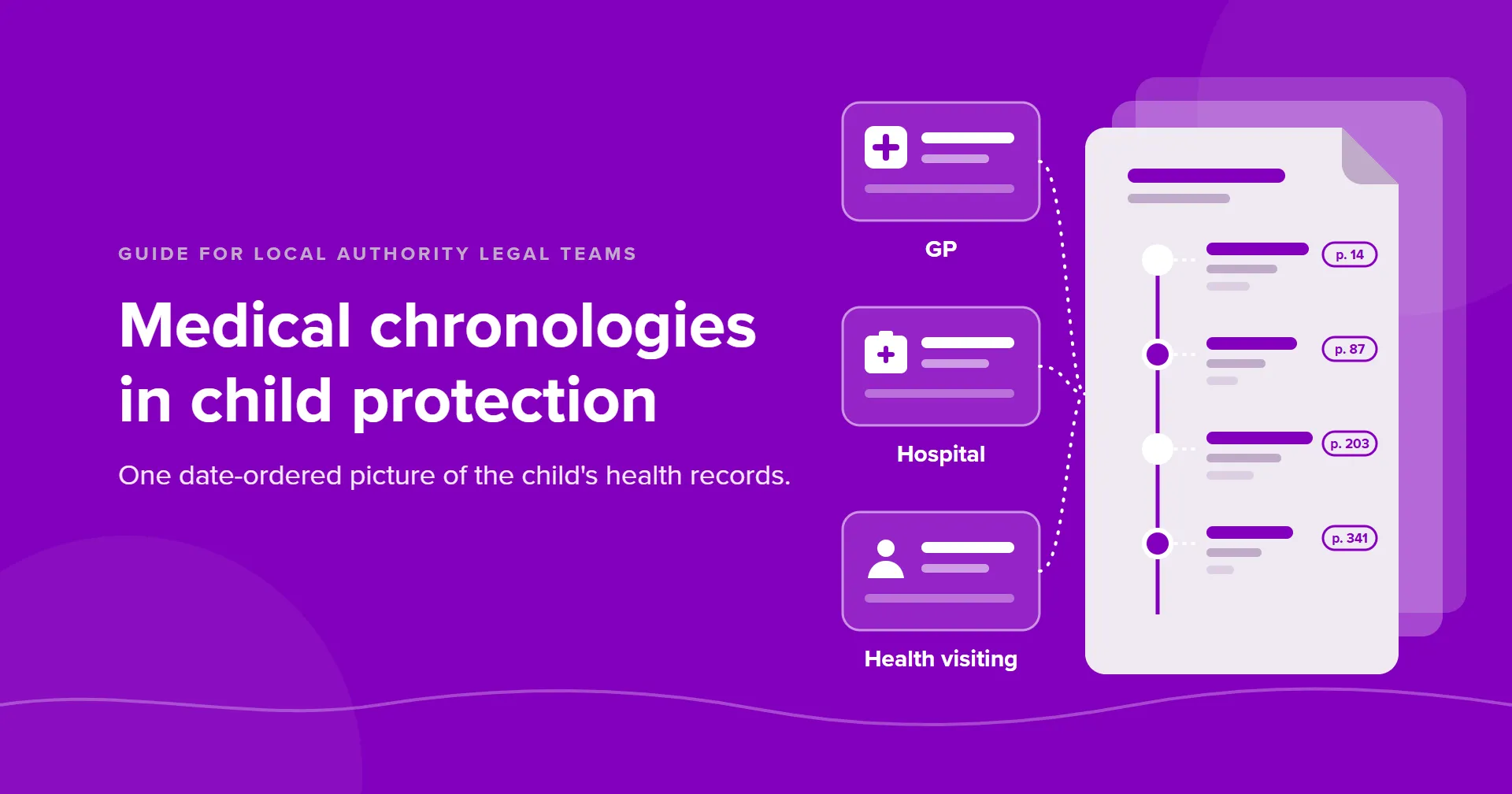
A medical chronology in a child protection case is a date-ordered account of a child’s health history, drawn from GP, hospital, health visiting and other records, with every entry referenced back to the page it came from. It gives the local authority, the children’s guardian, the parents’ representatives and any instructed expert one shared picture of what happened, when, and what was written down at the time.
Health records in care proceedings are rarely small. A single child’s history can sit across more than one GP practice, a couple of hospital trusts, health visiting and school nursing services and, where the concerns involve the adults, the parents’ own records too. In a presentation on fabricated or induced illness cases, Penny Howe KC of Pump Court Chambers suggests that teams consider instructing a chronology service, particularly when the records run to thousands of pages. This article looks at what a good medical chronology contains, how it differs from the chronologies councils already keep, and where it helps in the case types that come up most often.
What is a medical chronology in a child protection case?
It is a factual timeline of the child’s contact with health services, built from the disclosed records rather than from memory or summary. Each entry records the date, the service, who was involved, what was reported, what was observed and what action followed, with a page reference so anyone can check the original.
The purpose is different from a clinical negligence chronology. In a negligence claim, the timeline is usually built to test whether care fell below a reasonable standard. In child protection work, the questions tend to be about patterns: how often the child was seen, whether the accounts given at each attendance stayed consistent, who was caring for the child at the relevant times, and whether appointments that mattered were kept. (We cover the negligence side in our article on medical chronologies for personal injury and negligence claims.)
It is also worth separating two documents that share a name. The Royal College of Paediatrics and Child Health (RCPCH) guidance on perplexing presentations and fabricated or induced illness describes a health chronology compiled by health professionals, led by a senior clinician such as a consultant paediatrician, to inform the clinical and safeguarding response. A medico-legal chronology is prepared later, from the records disclosed in the proceedings, to help the legal team and the experts work from the same evidence. The two can sit alongside each other, and one does not replace the other.
Whose records go into the chronology?
That depends on the concerns in the case and on what the court has directed to be disclosed. In practice, the sources that most often matter are:
- The child’s GP record, including records transferred from previous practices if the family has moved.
- Hospital records, including emergency department attendances, paediatric admissions and outpatient letters.
- Hospital safeguarding records, which the same Pump Court Chambers presentation notes are often kept separately from the main hospital file and should be asked for specifically.
- Health visiting records, which cover the mandated reviews in early childhood set out in England’s Healthy Child Programme.
- Midwifery and maternity records, where the concerns go back to pregnancy or the first weeks of life.
- School nursing, CAMHS and therapy records, including private clinics and therapists.
- Siblings’ records, where the concerns cover more than one child.
- The parents’ own medical records, where relevant and permitted, sometimes filtered for relevance before they are shared.
Gaps are as important as entries. If a hospital trust’s records stop abruptly, or a GP record makes no mention of an attendance that appears elsewhere, the chronology should say so. Missing records found early can be requested while there is still time in the timetable.
What can a medical chronology show in different types of case?
Non-accidental injury
In suspected physical abuse, the chronology sets out each presentation in order: the time the child arrived, the history given and by whom, the examination findings, the investigations requested and when they were carried out. For younger children, imaging is often central. Royal College of Radiologists guidance on suspected physical abuse in children under two notes that the skeletal survey is often the first radiological investigation, so knowing exactly when scans were taken and reported can matter a great deal.
The medical timeline is only part of the picture. In Re R (Children: Findings of Fact) [2024] EWCA Civ 153, the Court of Appeal said medical and non-medical evidence each play their part and “neither of them has precedence over the other”. A chronology that sits the clinical entries alongside the recorded accounts of who was present makes that kind of integrated assessment easier.
Neglect
Neglect usually shows itself through accumulation rather than a single event, which is exactly what a chronology is good at revealing. NICE guideline CG89 advises clinicians to consider neglect where parents or carers repeatedly fail to bring a child to follow-up appointments essential to the child’s health, or persistently fail to engage with immunisation, health and development reviews or screening. Scattered across separate records, those patterns are easy to miss. Set out in date order, they are much harder to overlook.
Language matters here too. Many health services now record a missed child appointment as “was not brought” rather than “did not attend”, because a young child cannot get to an appointment alone. The NSPCC explains the reasoning behind the change. A careful chronology keeps the wording used in the original record and notes any reason recorded for the missed appointment, because a missed appointment on its own does not establish neglect.
Fabricated or induced illness and perplexing presentations
The RCPCH uses the term perplexing presentations for situations where there are alerting signs of possible fabricated or induced illness (FII), but the child’s actual state of health is not yet clear. The essence of those alerting signs, according to the RCPCH guidance, is a discrepancy between what is reported, how the child presents and what professionals independently observe.
These cases often involve many providers over several years, with symptoms reported to one service and not another. The RCPCH guidance describes chronologies as particularly valuable where the extent or pattern of past reported illness is uncertain, or where a case has to be made for the significant harm threshold. A medico-legal chronology that brings every provider’s entries into one sequence lets the expert see those discrepancies without reconstructing the history from scratch. We covered this area in more depth in our article on fabricated or induced illness in children.
How is a medical chronology different from the social work chronology?
Most local authorities already keep a chronology of significant events. Council practice guidance, such as Ealing’s chronology guidance, lists health entries for it, including medical appointments and missed appointments, attendances at A&E or urgent care, developmental checks, immunisations and child protection medicals.
The social work chronology records that those events happened. The medical chronology goes into what the health records actually say about them: the history given, what was found, the plan and whether it was followed through. Used together, they let the legal team test the local authority’s case against the primary health evidence before the expert, the guardian or the parents’ representatives do.
What makes a medical chronology reliable?
The RCPCH guidance sets out principles for health chronologies in FII cases. In our view they apply just as well to any chronology used in proceedings:
- Objective selection. Entries are chosen because they are significant, not because they support a particular conclusion.
- Balance. Positive information, such as normal test results or good engagement with services, belongs in the chronology alongside the concerns.
- Facts kept apart from analysis. What the record says is set out separately from any commentary on it.
- Clear sourcing. Every entry shows who recorded it and where, with a page reference to the bundle.
A chronology that leaves out the inconvenient entries will not survive contact with the other parties, and it can mislead the expert who relies on it.
How can a chronology help with the 26-week timetable?
Under section 32 of the Children Act 1989, care and supervision applications are to be decided within 26 weeks of issue, with the Public Law Outline in Practice Direction 12A setting the stages. That target is still hard to meet. In Local Government Lawyer’s 2026 survey, 69% of respondents saw delays at the evidence gathering and pre-proceedings stage, more than at any other point. The same publication reported that the average public law case took 32 weeks in December 2025, down from 39 weeks in December 2022.
A chronology will not solve every cause of delay, and many of them have nothing to do with health records. Where the health evidence is a bottleneck, though, having the records sorted, paginated and summarised early means missing records surface sooner, experts can be instructed with a clear set of papers, and advocates spend their preparation time on the issues rather than on finding the right page.
How MRC prepares medical chronologies
Our approach is AI-driven and clinically led. MRC Pre-Sort uses our own private AI to sort records into date order, and our clinical team checks the result before anything is returned. The records are never processed on open platforms or public AI tools.
MRC Pagination then turns them into a paginated, indexed and searchable bundle, with duplicates removed and a clickable index. It includes a clinical chronology highlighting key treatments and gaps, an expert memo with nurse commentary on missing records and any concerns, and a radiology schedule summarising imaging dates, types and providers. Where scans arrive on encrypted discs or as DICOM files, MRC Radiology converts them into a format the legal team and the experts can open. You can read more about the timeline itself on our MRC Chronology page.
We are careful about one thing. Our role is to organise the records and set out accurately what they say. Whether a child has suffered harm, and why, is for the treating clinicians, the instructed experts and ultimately the court.
If your team is preparing for a case with a large volume of health records, we would be glad to talk it through. Visit mrcgroup.uk, call 0161 928 1636 or email info@mrcgroup.uk.
Questions solicitors ask
Who prepares the medical chronology in care proceedings?
It varies. Some local authority legal teams prepare their own, some cases rely on a health chronology from the treating health team, and many teams instruct a specialist provider when the records are large. The court's directions set out what is needed and by when.
Does a medical chronology replace the medical records?
No. A chronology is a guide to the records, not a substitute for them. Every entry should carry a page reference so the expert, the advocates and the court can go straight to the original document.
Should the parents' medical records be included?
Only where they are relevant to the issues and their disclosure has been permitted. Parents' records can contain sensitive material unrelated to the case, so they are sometimes reviewed for relevance before being shared with the other parties.
Can a chronology show that records are missing?
Yes, and this is one of its most practical uses. Gaps in time, references to letters or scans that are not in the bundle, and providers mentioned but not disclosed can all be flagged, so further disclosure can be requested early.
Does the chronology give an opinion on whether abuse happened?
A medico-legal chronology should not. It sets out what the records say, objectively and with balance. Opinion on causation and harm belongs to the instructed experts and, in the end, to the court.