


Clinically reviewed by Eleanor Reid, Registered Midwife, and Happiness Okoro, Registered Midwife. Last reviewed 28 September 2026.
A maternity record set is the full collection of clinical records created for a mother and her baby across pregnancy, labour, birth and the neonatal period. In a birth injury case it is often the largest and most complex set of records a legal team will review, and knowing how to read it quickly and accurately can shape the case.
Maternity claims are also disproportionately significant. According to NHS Resolution's 2025/26 annual report and accounts, obstetric claims made up around 11% of clinical negligence claims by volume but roughly 55% by value, and about £1.3 billion of clinical negligence payments that year related to maternity.
This guide explains what a maternity record set typically contains, how it reaches a legal team, and what to look for when reviewing it.
What is a maternity record set?
A maternity record set is the complete collection of clinical records generated for a mother and her baby across the maternity pathway, from the booking appointment in early pregnancy through labour and birth to postnatal and neonatal care. Because it covers two patients and several care settings, it is usually longer and more fragmented than a single-admission hospital record, and it draws on community midwifery, hospital obstetrics and neonatal services.
That breadth is the first practical challenge. A single case can run to hundreds of pages spanning antenatal clinics, ultrasound and screening, triage attendances, the intrapartum record, theatre and anaesthetic notes, and neonatal admission. Sorting that into a clear, date-ordered sequence is the necessary first step before any meaningful review can begin, and it is the work that a clinical chronology and a properly paginated and indexed bundle are designed to support.
The maternity record set at a glance
The set can be read in the stages that follow the maternity pathway. The table below summarises what each stage typically contains and what a reviewer should look for.
| Stage | Key documents | What to look for |
|---|---|---|
| Antenatal | Booking history and risk assessment, personalised care plan, growth and ultrasound reports, blood and screening results, antenatal admissions, and any CTG recordings made before labour | Which risks were known before labour, whether the monitoring plan was documented, and whether any antenatal concerns were identified and acted on appropriately |
| Intrapartum | Partogram, induction of labour (IOL) records, labour notes, triage records, intrapartum management plan, fetal monitoring record and CTG traces | Whether the agreed monitoring method was used and recorded, how labour progressed, whether the CTG was interpreted correctly, and whether any concerns or deviations were acted on promptly |
| At birth (part of the intrapartum record) | Apgar scores, paired umbilical cord blood gases, resuscitation record | The baby's condition and acid-base status, considered alongside the CTG, and whether appropriate action was taken if there were concerns immediately after birth |
| Neonatal and postnatal | Neonatal admission and neonatal unit notes, therapeutic cooling records, postnatal notes and observations, the mother's postnatal readmission records where applicable, and any safety investigation report | Escalation, treatment including cooling, whether mother and baby received appropriate care with concerns actioned, and any independent investigation findings |
How do maternity records reach a legal team?
Maternity records are obtained through a formal request, and the route depends on whether the patient is living or has died. Under the Pre-Action Protocol for the Resolution of Clinical Disputes, copy records should be provided within 40 days of a request, and the protocol expects the claimant to place legible copies into an indexed and paginated bundle that is kept up to date.
For a living patient, records are obtained through a subject access request under the UK GDPR and the Data Protection Act 2018, and copies cannot be charged for unless the request is manifestly unfounded, excessive or repetitive.
Where the patient has died, which arises in stillbirth, neonatal death and maternal death cases, access is instead governed by the Access to Health Records Act 1990. Under that Act, only the deceased's personal representative or a person who may have a claim arising from the death can obtain the records, usually on production of a grant of probate or an explanation of the potential claim, and since the Data Protection Act 2018 those records must be provided free of charge.
Getting the request route right at the outset avoids delay and the risk of an incomplete disclosure. Records may also be disclosed in different formats, particularly where they have been generated across multiple providers or electronic systems, so it is important to establish whether the disclosure is complete.
Are maternity records paper or electronic now?
Most maternity records are now electronic, largely from the 2020s, though records relating to older incidents may still exist only as the original paper notes. NHS maternity services have largely moved from paper handheld notes, the old "green books" or handheld antenatal records, to full electronic maternity records, with many trusts using the BadgerNet Maternity system. Its companion app is used by around 200,000 women each month, and the system records events in real time and holds integrated CTG traces, digital partograms, blood loss monitoring and growth charts in one record.
For a reviewer, this changes what arrives on disclosure. An electronic maternity record is often exported as a large set of reports and screens rather than a slim folder, and the same event may appear in more than one place. This makes it important to understand the source and context of each entry rather than treating duplicate entries as separate events. Timestamps, authorship and the sequence of entries carry real weight, so the way the export is structured and ordered has a direct bearing on how readily the account of care can be followed.
What is in a maternity record set?
Each stage of the record set contains its own documents. Understanding what each should contain is what allows a reviewer to see quickly whether anything is missing or inconsistent. It is also important to distinguish between the mother's records and the baby's records, as these may be held and disclosed separately.
Antenatal records
Antenatal records establish the baseline. They include the booking history and risk assessment, the personalised care plan, growth and ultrasound reports, blood and screening results, and any antenatal admissions and CTG recordings that took place before labour.
Under NICE guideline NG229 on fetal monitoring in labour, the discussion about how the baby will be monitored should take place during antenatal care and be documented in that care plan, and any risk factors identified antenatally should already be recorded there. These records show which risks were known before labour began, and what action was taken to support wellbeing and outcomes, such as any medication prescribed during pregnancy.
Intrapartum records
The intrapartum records document labour itself, and they are usually where the key events sit. They include induction of labour (IOL) records where applicable, the partogram, contemporaneous labour notes, triage records, the intrapartum management plan and the fetal monitoring record. Many units also record peer reviews of monitoring, for example "fresh eyes" reviews of a CTG, within the electronic record.
NICE recommends that for women at low risk of complications, fetal heart monitoring in established labour is by intermittent auscultation using a Pinard stethoscope or a Doppler, carried out immediately after a contraction for at least one minute and repeated at least every 15 minutes, and every 5 minutes, or after every contraction, in the second stage of labour. Continuous CTG is offered where risk factors are present, whether known antenatal risks such as gestational diabetes or risks that arise once labour is under way such as raised blood pressure.
Whether the recommended method was used and recorded, whether the fetal heart rate was interpreted correctly, and whether prompt action was taken when there were deviations from the normal pattern, is often central to a review.
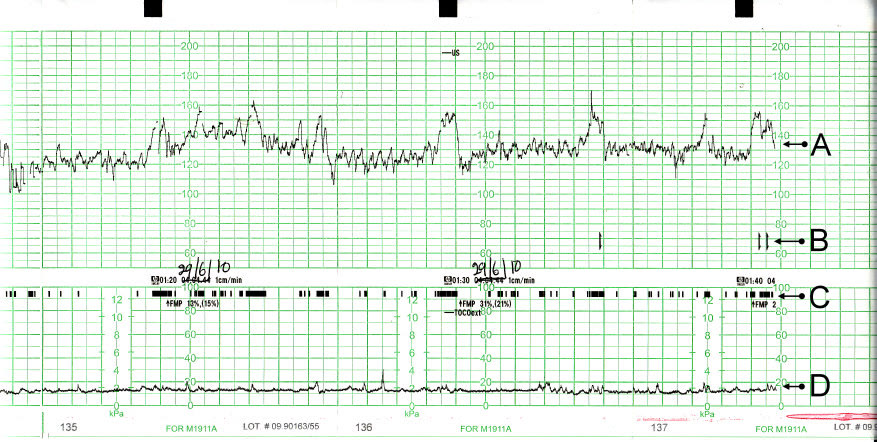
The CTG trace
The cardiotocograph, or CTG, is the single most scrutinised element of many maternity cases, because it records the fetal heart rate and uterine contractions during labour. Fetal monitoring in England is now governed by NICE NG229, published in December 2022, which replaced the fetal monitoring section of the intrapartum care guideline and simplified how CTG traces are interpreted and categorised.
The guidance stresses that the CTG is only one part of a wider clinical picture, and that a change in its categorisation sits alongside other intrapartum risk factors such as sepsis, slow progress, meconium and excessive contraction frequency. The guideline is also kept under review: a 2025 amendment clarified that late decelerations are treated as a concerning, red-category feature because they are associated with fetal hypoxia. NICE has also removed its previous recommendation to use fetal blood sampling as a second-line test and now makes no recommendation for or against it, citing limited evidence, so older records may reflect a practice that current guidance no longer endorses.
Records at birth: Apgar scores and cord blood gases
At delivery, a few key records anchor the baby's condition. The Apgar score, which has been used routinely to assess every baby after birth since the 1950s, rates appearance, pulse, grimace, activity and respiration, and is recorded at one and five minutes. Each category is scored from 0 to 2, with 10 being the highest, indicating that the baby appears healthy and well after birth.
When required, usually where there are signs of fetal distress or in an instrumental or operative delivery, paired umbilical cord blood gases, taken from the artery and vein, give an objective measure of the baby's acid-base status at birth and are regarded as the reference standard for that assessment. A widely used definition of significant metabolic acidosis at birth, from the American College of Obstetricians and Gynecologists, is an umbilical artery pH below 7.0 with a base deficit of 12 mmol/L or more, which is equivalent to a base excess of -12 mmol/L or lower.
The important point for a reviewer is that no single figure settles the picture. On its own, cord pH is a weak predictor of hypoxic-ischaemic injury, but considered together with the CTG, the Apgar scores and any need for resuscitation it becomes far more meaningful.
Neonatal and postnatal records
The final stage covers the baby after birth and the mother afterwards. Neonatal records include resuscitation notes, admission and neonatal unit records, and, where a hypoxic-ischaemic brain injury is suspected, records of therapeutic cooling if the criteria were met and it was undertaken.
Postnatal records complete the account of the mother's recovery and any complications, as well as routine postnatal care, including home visits after hospital discharge. Postnatal readmission records may also appear where concerns arose after discharge and the mother needed to be readmitted to the maternity unit.
Why must the record be read as a whole?
Because in maternity cases the meaning is in the relationships between records, not in any one of them. The CTG, the partogram, the labour notes, the cord gases and the Apgar scores each describe a different facet of the same short window, and the account only becomes clear when they are aligned on a single timeline. A trace that looks concerning may be explained by a documented action taken minutes later, and a normal cord pH may sit against notes that tell a different story.
Looking at every element together is what builds an accurate clinical picture of whether concerns were developing, whether they were visible in the records, and whether they were acted on, which can show whether harm might have been noticed earlier and possibly prevented. This matters most where the significance of an event only becomes clear alongside what happened immediately before and after it. It is why a medically informed chronology, one that places events in order and highlights key treatments and any gaps, does more for a reviewer than a paginated bundle alone.
What happens when records are missing or incomplete?
Gaps in a maternity record set are themselves significant, and spotting them is a clinical judgement. A CTG trace that was not retained, a partogram with unexplained gaps, a missing set of observations, or an entry that does not reconcile with the surrounding notes can each affect how a case is understood.
Identifying which absent or inconsistent document actually matters, rather than simply noting that something is not there, is where clinical and record-review experience earns its place. It can also inform an early view on whether a case has clinical merit, which is the purpose of a clinical screening review. At MRC, this is also the role of the expert memo that accompanies a paginated bundle: a nurse or midwife commentary flagging missing records, concerns, or points that may need an expert's attention.
How long are maternity records kept?
Maternity records are kept for 25 years after the birth of the last child, longer than most other health records. This retention period is set out in the NHS Records Management Code of Practice, and it reflects the long timescales over which maternity and birth injury issues can come to light. For legal teams, it means historic records should generally still be obtainable, though their format and completeness can vary with the era in which they were created.
How does MRC approach maternity records?
MRC's obstetric and birth injury work is handled by its midwife team, who have many years of clinical working experience, and this is where AI-driven sorting and clinically led review come together. The records are organised into a clear, date-ordered, searchable structure, then reviewed by clinicians who understand what a maternity record should contain.
The result is a court-compliant bundle from MRC Pagination, prepared in line with the Civil Procedure Rules and HMCTS e-bundle guidance, with a clickable index, a clinical chronology, a radiology schedule summarising imaging from MRC Radiology, and the expert memo flagging anything that warrants a closer look. The aim is simple: to let legal teams and experts spend their time on the case rather than on the records.
Key takeaways
- A maternity record set spans antenatal, intrapartum, birth and neonatal care, and now usually arrives as a large electronic export.
- The access route differs for living and deceased patients, and getting it right avoids delay.
- The CTG, partogram, cord gases and Apgar scores must be read together on one timeline, not in isolation.
- Missing or inconsistent records can be as significant as what is present, and identifying that is a clinical judgement.
- A medically informed chronology and a clean, indexed bundle turn a complex record set into usable evidence.
Frequently asked questions
What is BadgerNet?
BadgerNet is an electronic maternity record system used by many NHS trusts in England. It records maternity care in real time and holds integrated CTG traces, digital partograms and other clinical entries in a single record that can follow the woman from booking to postnatal discharge.
What is a partogram?
A partogram is the chart used to record the progress of labour over time, including the fetal heart rate, contractions, cervical dilatation and other maternal observations. It gives a full overview of the entire labour. In electronic records it is usually a digital partogram, and gaps or inconsistencies in it can be significant when a case is reviewed.
Who can request a deceased patient's maternity records?
Under the Access to Health Records Act 1990, access to a deceased patient's records is limited to the personal representative of the estate or a person who may have a claim arising from the death, usually on production of a grant of probate or an explanation of the potential claim.
How long must CTG traces be kept?
CTG traces form part of the maternity record, so they fall under the maternity retention period of 25 years after the birth of the last child set out in the NHS Records Management Code of Practice. Whether a trace was retained can be an important point in a review, and older paper traces are sometimes received in poor quality because the print ink fades over time.
Need support with a maternity record set?
Ready to turn a complex maternity record set into usable evidence? Our midwife-led team can collate, paginate and review maternity records so your team can focus on the case. Read more about our support for birth injury cases, or get in touch on 0161 928 1636 or info@mrcgroup.uk.
This article provides general information about medico-legal record review. It is not legal or medical advice.
Sources
- NHS Resolution, Annual Report and Accounts 2025/26
- NICE guideline NG229, Fetal monitoring in labour
- NICE NG229, Context
- NICE NG229, Recommendations
- NICE NG229, Update information
- NHS Records Management Code of Practice
- Pre-Action Protocol for the Resolution of Clinical Disputes
- Access to Health Records Act 1990
- House of Commons Library, Accessing health records
- Cord Blood Gas, StatPearls (NCBI Bookshelf)
- BadgerNet Maternity, System C